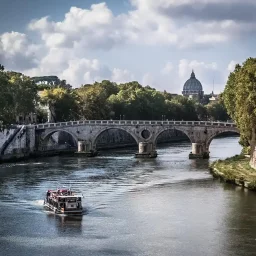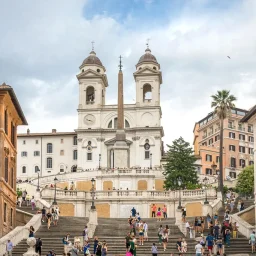


Rome is often described as a city frozen in time, but nothing could be further from the truth. What makes Rome extraordinary is not immobility, but constant transformation. Over more than two millennia, the city has reinvented itself repeatedly, moving from the heart of a vast empire to a spiritual capital, from a medieval stronghold to the capital of a modern nation-state. Understanding the history of Rome through the centuries means following a long process of adaptation, decline, rebirth, and reinvention.
Rome’s story is not linear. It is made of ruptures and continuities, moments of loss and unexpected resilience. Each era left visible traces, shaping what we now recognize as Rome.
Rome from empire to capital: the ancient foundation
At its peak, ancient Rome was the center of the Mediterranean world. As the capital of the Roman Empire, the city governed territories stretching from Britain to the Middle East. Political power, military command, and cultural authority were concentrated within its walls.
Monuments such as the Colosseum, the Roman Forum, and the imperial palaces were not only architectural achievements; they were tools of communication. They projected the idea of Rome as eternal, invincible, and divinely favored.
Yet even at the height of imperial power, Rome was already changing. As the empire expanded, administrative functions gradually shifted elsewhere. Rome remained symbolically central, but the seeds of transformation had been planted.
Late antiquity and the end of imperial Rome
Political decline, symbolic survival
Between the 4th and 5th centuries, Rome lost its role as an effective political capital. Emperors ruled from cities closer to the empire’s borders, and Rome suffered population decline, invasions, and economic contraction.
The fall of the Western Roman Empire did not mean the disappearance of Rome, but it marked a profound shift. The city ceased to be the administrative heart of an empire, yet it retained immense symbolic value. This paradox lies at the core of Rome from empire to capital: Rome lost power but gained a different kind of authority.
Christianity and a new centrality
As imperial structures weakened, Christianity transformed Rome’s identity. The city became the seat of the papacy, and spiritual leadership replaced imperial governance. Martyrdom sites, basilicas, and pilgrimage routes redefined Rome as a religious capital rather than a political one.
This transition ensured continuity. While other ancient capitals faded, Rome remained relevant by anchoring itself to a new universal mission.
Medieval Rome: contraction and survival
During the Middle Ages, Rome was a far smaller city than in imperial times. Large areas were abandoned, monuments collapsed or were reused, and daily life clustered around fortified zones.
Yet medieval Rome was never just a city in decline. It was a place where memory mattered deeply. Ancient ruins were not erased; they were integrated into churches, palaces, and defensive structures. This layering of past and present is a key feature of Rome’s historical evolution.
Pilgrimage played a crucial role in keeping Rome alive. Travelers from across Europe ensured a constant flow of people, ideas, and resources, reinforcing Rome’s spiritual importance even in times of political instability.
Renaissance Rome and the rediscovery of antiquity
Rebuilding the image of Rome
From the 15th century onward, Rome underwent another dramatic transformation. Renaissance popes sought to restore the city’s grandeur by reconnecting it with its ancient past. Classical ruins became sources of inspiration, study, and legitimacy.
Artists and architects reinterpreted ancient forms, turning Rome into a living laboratory of art, science, and symbolism. The city once again projected universal ambition, this time through culture rather than conquest.
Rome as a cultural capital
Renaissance Rome attracted thinkers, artists, and travelers, reinforcing its status as a global reference point. The city’s identity shifted toward intellectual and artistic leadership, adding another layer to its complex evolution.
This period strengthened the idea of Rome as timeless: a city capable of renewing itself by re-engaging with its own past.
Modern Rome history: becoming a national capital
Rome and Italian unification
One of the most radical transformations in modern Rome history occurred in the late 19th century, when Rome became the capital of a unified Italy. This marked a return to political centrality after centuries of religious dominance.
Becoming a national capital required massive urban change. New districts were built, infrastructure expanded, and the city was reshaped to serve administrative and symbolic functions of a modern state.
This phase was not without tension. Balancing ancient heritage with modern needs became a defining challenge, one that Rome still navigates today.
A city between past and present
Modern Rome is characterized by coexistence rather than replacement. Ancient ruins stand beside government buildings, Renaissance palaces house modern institutions, and daily life unfolds among layers of history.
This coexistence explains why Rome feels both ancient and contemporary. It is not a city that chose one identity over another, but one that accumulated them.